
The results suggest CRPS symptoms may stem from functional brain changes rather than permanent structural injury.
A new study led by Dr Audrey Wang and colleagues at NeuRA has delivered a detailed examination of white matter structure in people with Complex Regional Pain Syndrome (CRPS).
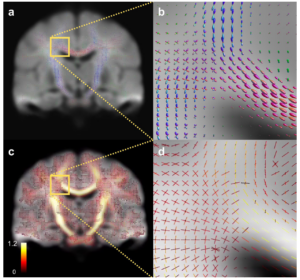 Recently published in the European Journal of Pain, the study used high angular resolution diffusion imaging and a fixel‑based analysis approach; the team compared 21 individuals with unilateral upper‑limb CRPS to 21 matched healthy controls. This fine‑grained method allowed researchers to assess specific white matter fibre populations rather than relying on traditional diffusion tensor measures, which can be limited in regions containing crossing fibres.
Despite previous studies reporting altered white matter metrics in CRPS, this research found no significant structural differences between individuals with CRPS and healthy controls. Measures of fibre density, fibre cross‑section, and their combined metric (FDC) were statistically equivalent across groups.
Even after adjusting for age, sex, intracranial volume, hand dominance, and opioid use, the researchers did not detect meaningful differences in any whole‑brain or tract‑specific analyses. These findings suggest that white matter structural abnormalities are unlikely to explain CRPS symptoms or maintain the condition.
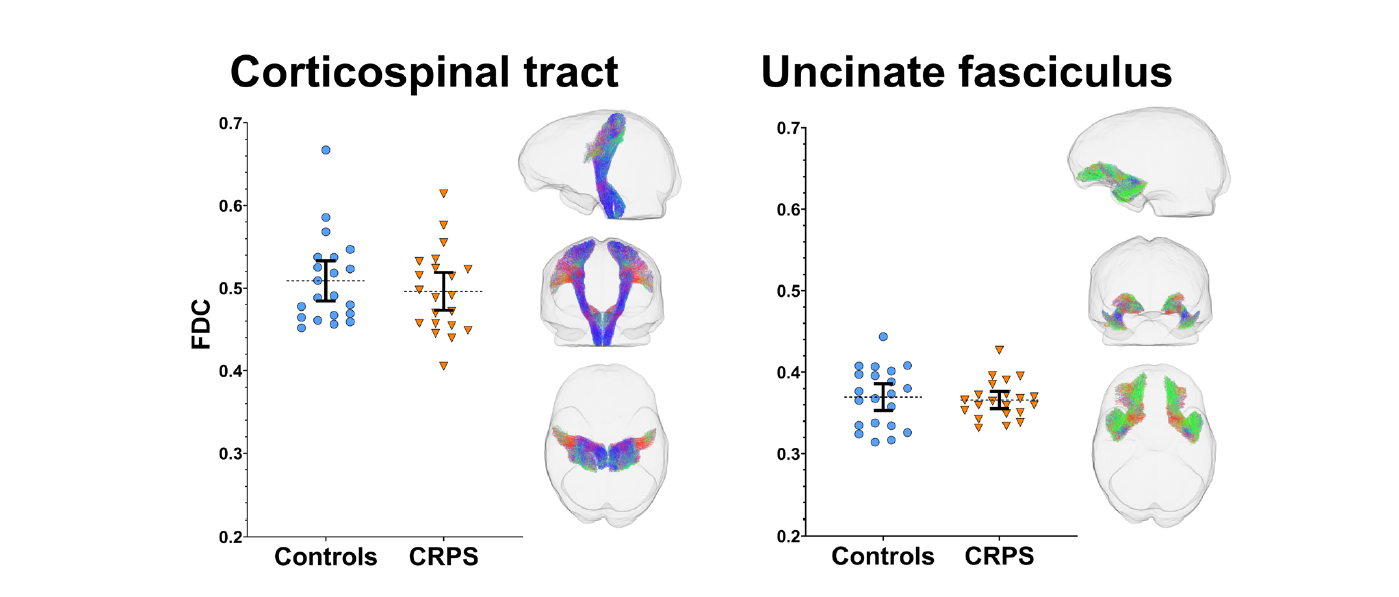
The results challenge the long‑held assumption that persistent pain in CRPS is driven by long‑lasting structural changes in the brain. Instead, the authors propose that functional changes, rather than structural ones, may underpin the sensory, motor and autonomic disturbances seen in CRPS. This interpretation aligns with emerging research pointing toward functional reorganisation and altered connectivity rather than fixed anatomical disruption.
Encouragingly, this supports continued emphasis on treatments targeting neural function, including graded motor imagery, graded exposure, desensitisation and movement‑based rehabilitation.
With one of the largest CRPS diffusion MRI cohorts examined to date and the use of high‑quality HARDI acquisition, this study provides strong evidence that white matter microstructure remains intact in CRPS. The authors note that future work, especially longitudinal and multi‑shell diffusion studies, may shed further light on the temporal and functional dynamics of the condition.
For now, these findings offer reassuring news to clinicians and patients, highlighting that recovery remains anatomically plausible and that brain structure does not appear to pose a barrier to improvement.
The full publication can be found in the January 2026 issue of the European Journal of Pain.
Recent Comments